
Why Small Meeting Spaces Are the New Productivity Bottleneck
And what office and workplace administrators, and their IT teams can do about it
For years, workplace strategy has revolved around large and medium-sized meeting rooms. Booking panels, calendars, and utilization reports have helped organizations optimize these spaces.
But something has changed.
Today’s offices are increasingly shaped by hybrid work, free seating models, and frequent one-to-one digital meetings. As a result, small, non-bookable rooms, focus rooms, quiet rooms, and drop-in spaces, have become some of the most in-demand areas in the workplace.
And yet, these rooms are often the least managed, and without any visual indication of availability.
The blind spot in modern offices
Most small meeting rooms and focus rooms don’t have booking panels. There’s no calendar to check, no status indicator, and no easy way to see if the room is available without physically looking into the room or knocking on the door.
The result is familiar to anyone working in an office:
- Employees hovering in hallways, peeking through glass doors
- Interruptions caused by people checking if a room is free
- Time wasted walking between floors or zones searching for space
Studies show that employees can spend up to 20–30 minutes per day just looking for an available meeting room, even while suitable spaces sit unused elsewhere in the building. This lost time quickly adds up across teams and departments.
For workplace leaders, office administrators and office workers, this creates frustration.
For IT teams, it exposes a gap between traditional meeting rooms with booking panels, and smaller rooms without… anything.
Small meetings now dominate the workplace
Workplace research consistently shows that the majority of meetings today consist of digital one-to-one meetings, or small groups, especially in hybrid environments. These are often short, spontaneous, and not planned in advance.
Traditional room booking systems were never designed for this behavior. They work well for scheduled meetings in larger rooms, but they struggle to support:
- Ad-hoc conversations
- Focus rooms - for focused work
- Short video calls
- Quick check-ins
Mainly because it's too costly to install booking panels on all small rooms. But the need for visual indication is arguably even more important for these rooms.
Without clear visibility, these smaller spaces become a bottleneck, not because there aren’t enough rooms, but because people can’t easily tell which ones are available.
Why this matters for productivity and focus
Interruptions are more than a minor annoyance. Research shows it can take over 20 minutes to regain focus after being interrupted. When employees are disturbed mid-meeting or mid-task because someone is checking room availability, productivity suffers on both sides.
For organizations, this translates into:
- Reduced focus time
- Lower employee satisfaction
- Higher rate of task failure
- Increased pressure to add more space instead of using existing space better
Bringing visibility to small rooms with OccuLights
OccuLights is an out-of-the-box room occupancy solution designed specifically for smaller rooms that typically lack booking panels.
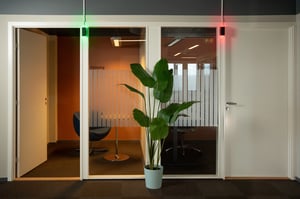
At the core of the system is a smart occupancy sensor installed inside the room. When the room is in use, the sensor automatically triggers an occupancy light mounted outside the room:
- Green means the room is available
- Red means the room is occupied
Employees instantly know whether a room is available, before they reach the door.
Built for modern office environments
OccuLights is designed to be easy to deploy and simple to manage:
- Quick installation with minimal infrastructure
- Clear visual status without screens or panels
- Seamless integration with Microsoft 365 for organizations that want deeper automation
- Data on room utilization for smarter, data-driven workplace decisions
For office administrators, it reduces friction and complaints.
For workplace leaders, space utilization improves.
For office workers, it protects focus time, and makes it easier to find available space
A small change with a big impact
As offices evolve, the smallest rooms often create the biggest challenges. By adding simple, real-time visibility to these spaces, organizations can unlock better flow, fewer interruptions, and a calmer workplace experience, without complex systems or heavy investments.