The moment that matters
It's 09:58. In two minutes, you're on a call that could change your year.
Maybe it's the client you've chased for six months. The candidate you really want to hire. Or a colleague who needs to hear difficult news from you, in private, with the door closed.
You grab your laptop and head down the corridor. The first door is shut, so you knock and open it a crack. "Sorry, sorry." The second room looks empty through the glass, but someone booked it and never showed up. The third has a team mid-discussion, and four heads turn towards you.
At 10:01 you finally sit down. Your pulse is up, your notes are buried in some tab, and the first words out of your mouth are "Sorry I'm late."
That's the moment Occulights is built for. Not the meeting itself, but the minutes before it, and the quiet you need once it starts.
Why do the minutes before a meeting matter so much?
Because friction adds up. Looking for a free room costs you time and composure, and every door you open interrupts someone else. Research by Gloria Mark at UC Irvine found it takes an average of 23 minutes and 15 seconds to get back to an interrupted task.
The numbers behind the feeling:
- Up to an hour a week. Four in ten office workers spend up to 60 minutes each week looking for available desks, meeting rooms or colleagues (Senion Office Worker Survey, via Facility Executive).
- 23 minutes to refocus. That's the average time to return to a task after an interruption (Gloria Mark, via Fast Company).
- One in four bookings is a ghost. At one Fortune 500 company, more than 25% of booked meetings never happened, but the rooms stayed blocked (Density).
Every knock on a door has two victims: the person searching, and the people inside who just lost their train of thought. Multiply that by every corridor, every floor, every day.
What can occupancy lights or light indicators do for you?
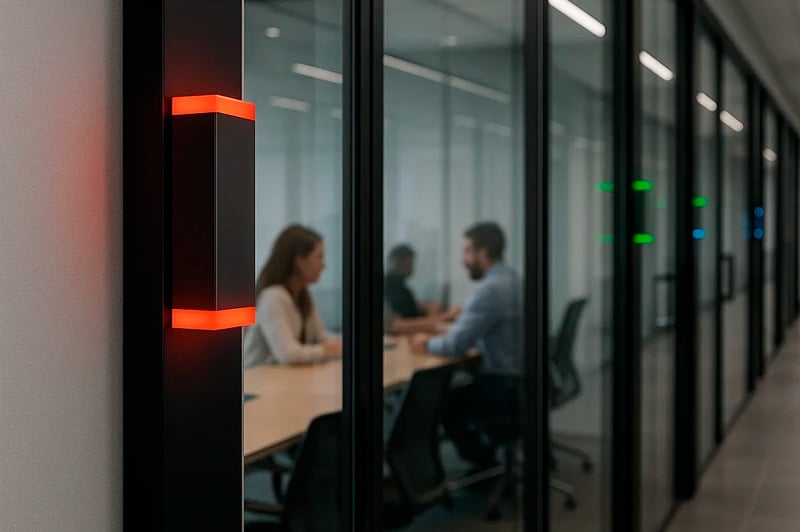
Occupancy lights are light indicators mounted outside a meeting room that show whether the room is free or in use. An occupancy sensor inside the room detects presence and switches the light automatically: green means free, red means occupied. They're also called meeting room light indicators, room occupancy indicators or busy lights.
What makes occupancy lights different from a booking screen or a calendar app:
- You see the answer from down the hall. No need to walk up to a door, read a panel or open an app.
- They show what's really happening. A calendar shows who booked a room. A light indicator driven by a sensor shows whether anyone is actually in it.
- They work for rooms nobody books. Focus rooms, phone booths and small huddle rooms are often drop-in only. Occupancy lights give those rooms a status, too.
- They protect the people inside. A red light is a polite, silent "please don't knock".
The same moment, with Occulights
It's 09:58 again. You step into the corridor and look down the hall. Two red lights, one green. You walk straight to the green one, close the door, and the light outside turns red behind you.
It's 09:59. You have a full minute. You take a sip of water, open your notes, and read your first line twice. Nobody knocks. Nobody peeks in.
At 10:00 you say "Good morning" instead of "Sorry I'm late."
That's what occupancy lights really give a workplace. Not just a light, but a feeling:
|
Without occupancy lights |
With Occulights |
|
|---|---|---|
|
Finding a room |
Walk, knock, apologise, repeat |
Look down the hall, walk to the green light |
|
Before the meeting |
Rushed and flustered |
Calm, with a minute to prepare |
|
During the meeting |
Doors opening, faces in the glass |
A red light outside keeps the room protected |
|
For colleagues |
Interrupted by people searching |
Left alone to focus |
|
For the workplace |
Rooms that feel full but often aren't |
Rooms that are used, and data to prove it |